
1983 Micro Change
In the third year of New Microman, Takara introduced a new type of Microman toy called Micro Change. These were ordinary objects that could "transform" into robots to fight alongside Microman.Takara also released the last of the New Microman - 011 Salam (reissued of Microman Command2 M16X) in several varieties of colors. The main focus of this year's series was the new sub-series of Microman called the Micro Change. While Takara still kept some interaction with the action-figure side it became clear by 1983 that the focus of the line had shifted from the old Microman action figures to Micro Robot action figures.
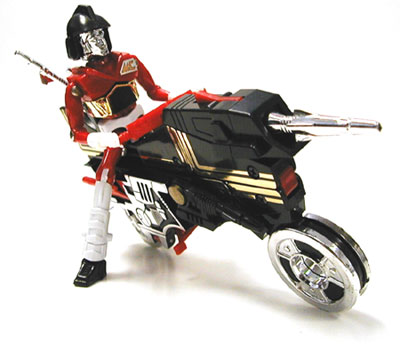
By 1983, there were many other changes that were going on in the toys industry with the popularity of shows like Gundam and the realistic robots depictions, older kids in Japan began to view transforming toys as childish. The transformation robot toys like Bandai popular Sentai Team (Power Ranger) and Takara Diaclone and New Microman began to suffer greatly in popularity. However, a show called Macross came on the scene and was able to combine the two concepts of realistic-looking objects with that of the giant robots with the legendary design - the Macross Valkyrie fighter. Takara took this concept of realistic objects that transform into robots and applied the idea to both the New Microman and Diaclone series. On the New Microman side, the line got a new sub-series called Micro Change and Diaclone got a new sub-line called Car Robot. Little did Takara know in 1983, that they had struck something big that would forever change not only Microman future but the future of both Japanese and American robot toys. The Micro Change series proved to be quite popular but ironically their popularity would soon bring about the end of the Microman line.
Diaclone - Microman Synergy and the rise of The Transformers.
by Paul L. and Bryan W.
From the beginning, it was obvious that there was some kind of connection between the, then, Takara's new Diaclone line and the relaunched 1981 Microman series. The recent research by my good friend Bryan uncovered the hidden synergy of the two lines that ultimately became the Transformers. It all began in the late 1970s when Takara hold of the sci-fi market was slipping. Microman popularity peaked in 1977 and has been on a steady decline since. By 1980, Takara decided on a new marketing strategy to take on the die-cast robot toys market dominated by the likes of Popy. Takara's planned was essentially to split their sci-fi series into two "scales" of toy lines. The action-figure line was left to the newly revamped Microman series called the "New Microman".
The new Microman pretty much took the concept started with the 1979-1980 series and expanded it further. The new line now focuses on Microman size transforming robots and armored suits that interact with the Microman scale figures. (Microman still retained their 1:1 scale). While the Microman line tackled the action-figures market, the new line called Diaclone was to take on the "giant robot" sector. Diaclone too began as a concept expanded from the Microman toys. By 1980, Takara already attempted to enter the giant robot market by introducing toys like Death King but this was not entirely successful due mainly to the fact that Microman at its core was still an action-figure line. So instead of introducing giant robots into the Microman line, Takara started with a new series that centered around giant robots. Diaclone shared much of the basis of late Microman design but the series was done on 1/60 scale with the "action figure" only about an inch tall. The focus of this line was of course on the giant bases and vehicles that could transform into robots for this miniature figure. (The figure had a chrome head and magnetic feet and looked much like a micro-scale Punch Microman). Diaclone was pretty much a Micropolis-realized something that Takara had long wanted to do for Microman but could not due to size. The robot and base literally formed a sci-fi world for these Diaclone figures. The figures in Diaclone became the "accessory" instead of the main focus.
By the early 1980s, both the toys and anime worlds were fast changing with the introduction of realistic robots with shows like Gundam and later Macross taking over the super-robot series. Takara designers seized on this "real" concept and spun it into their sci-fi lines. This was something that Takara seemed to always excel at, taking the popular concepts and adapting them to their line. Before 1983, most of the Diaclone and Microman toys featured futuristic designs, but that was all changed with the introduction of two new series - "Car Robot" for the Diaclone and "Micro Change" for the Microman. The "Car Robot" featured realistic-looking cars that could transformed into robots for the Diaclone pilot while the "Micro Change" (also known as Chameleon Good) featured realistic objects that transformed into robots and vehicles that interacted with the Microman figures. These two new lines were dubbed the "Real & Robot" line - a combination of "real" world objects with the fictional "robot". The "Real & Robot" would flourish for a couple of years until Hasbro (a US toy company) took these two "Real & Robot" lines and combined them together and gave them a whole new story called "The Transformers" for the US market.
The new series proved immensely successful and Takara decided to import the idea back to Japan. It was quite ironic that Hasbro accomplished what Takara had been trying to do since the day of the Victory Project - a unified single line for all of their main sci-fi toys. To be fair, Hasbro did have one big advantage over Takara, it was able to start from scratch with a new story something Takara could not do with their already established brand. This new "victory" for Takara however did not come without a cost. With the successful fusion of the two lines under the "The Transformers" banner, it was no longer necessary for Takara to keep neither the Microman nor the Diaclone line going. By 1985, both lines were canceled and replaced with the new single sci-fi line called "Fight Super Robot Life-form Transformers".
MICROMAN MICRO-CHANGE STORY
Using a subspace generator, ten MICROMAN survivors materialized on Earth after the loss of their homeworld known as MICROEARTH. This was quickly followed by the ACROYEAR invasion of our planet.
Thus began the conflict on Earth between MICROMAN and ACROYEAR.
Not long after these events, SALAM became the eleventh MICROMAN to reach our world, bringing with him the MICROM 2000 supercomputer, having rescued it during a harrowing last-minute escape from the final stages of MICROEARTH's destruction.
SALAM was an expert technician, and soon used the MICROM 2000 module to create an ever-expanding new series of MICROCHANGE mecha in order to try putting a stop to the ACROYEAR invasion.
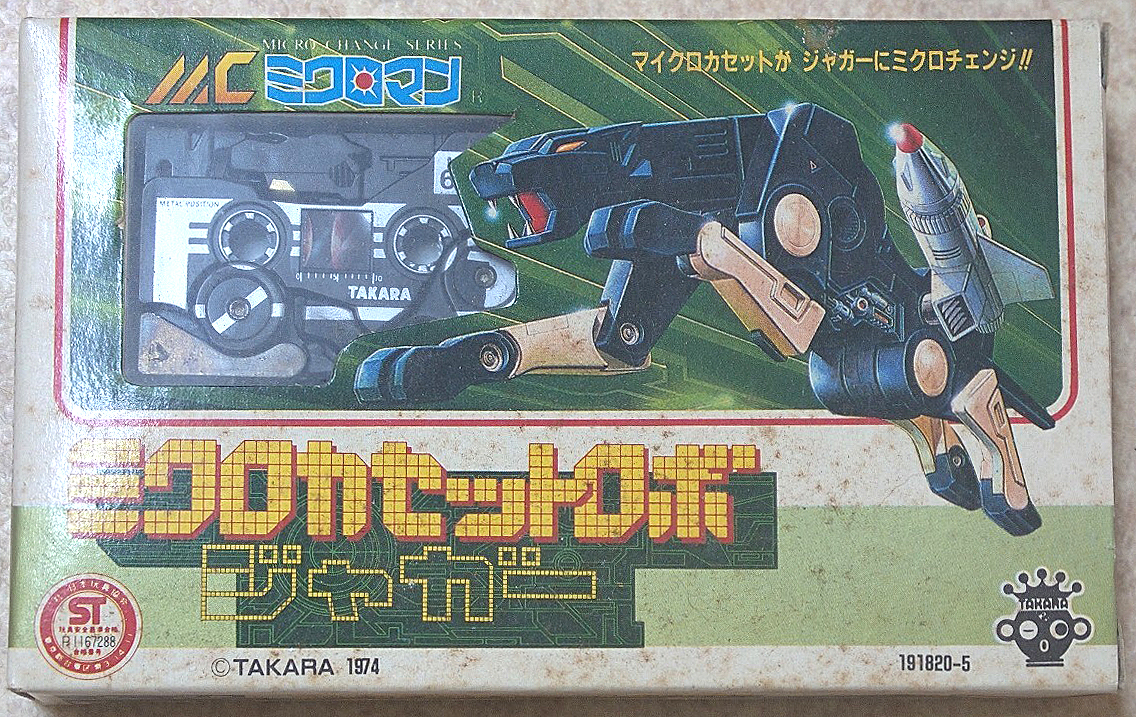
First, the MICROSS, CONDOR and JAGUAR MICROCASSETTEs were built and put in charge of terrestrial reconnaissance. Next CASSETTEMAN was constructed as an energy resupply base for the MICROCASSETTE corps, while the CASSETTE-MACHINE JET HELI and BATTLE BIKE were utilized by MICROMAN to engage the ACROYEAR threat.
Meanwhile, the ACROYEARS welcomed the Admiral ACRODEVIL as the new supervisor of their Earth operations, and were strengthening their military forces. The focus of their attacks would be upon MICROMAN and their friends, the Earthling children.
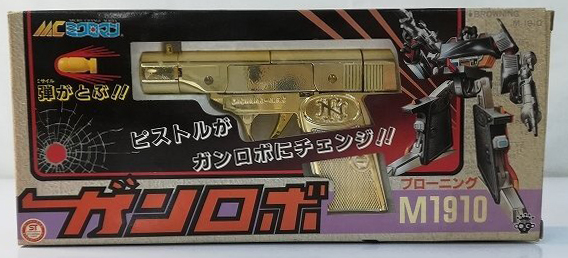
Therefore SALAM crafted the GUN ROBO in the shapes of model guns and entrusted the children with them. The GUN ROBO BROWNING, 44 MAGNUM and WALTHER could CHANGE into heavily armored robots in an instant and stand up to the ACROYEAR attacks.
The ACROYEARS thus began to extend their various subversive plots not only toward MICROMAN, but towards humanity as well. As such, being prepared for random ACROYEAR attacks popping in and out of subspace proved exceedingly difficult. Therefore, MICROMAN created CAMERA ROBO and WATCH ROBO with the ability to detect the ACROYEARs in defense of the Earth. As a direct result, the extra-dimensional ACROYEAR fortress was discovered at last and it finally became possible for MICROMAN to directly approach the enemy's headquarters.
In the meantime the ACROYEARS viciously counterattacked, but their tactics were repeatedly foiled by the mysterious METEOR ROBO.
The Admiral ACRODEVIL became so infuriated, he became intent on nothing less than the complete annihilation of the Earth. MICROMAN continued to produce more and more MICROCHANGE mecha and gave all their effort toward building their defenses.
KEY ROBO, RADICASSE ROBO, MICRO-SCOPE, SCOPEMAN, BEAM ROBO�this MICROCHANGE mecha squadron fights on to protect peace on this beautiful planet Earth, and the rest of the universe!!
(excerpt from the introduction to Microman Secret File Vol. 1, as translated by MicroBry)

ACTION FIGURES
New Microman
Micro Change Series
- MC01 MicroCassette Robo
- Blue Micross
- Red Micross
Microcasette Series
- MC02 MicroCassette Robo
- Blue Jaguar
- Black Jaguar
- MC03 MicroCassette Robo
- Orange Condor
- Red Condor
- Microchange Set
- MC04 Mini CAR Robo
- 01 Porsche 944 (red,yellow,blue)
- 02 XG1500 (red,yellow,blue)
- 03 VW Bug (red,yellow,blue)
- 04 4WD Truck
- 05 Jeep
- 06 Trans Am
- 07 Semi Truck
- MC06 Watch Robo
- Gold Type
- Black Type
- Blue Type
- Chrome Type
- Micro Change Machines Cassette Machines
- MC08 Battle Bike HG90
- MC09 Jet Heli XL120
- MC12 Gun Robo - Walther P38
- P38 Black Type
- P38 Gray Type
- Real Microman - Bio-Suits
- BS01 Mineral Searcher Type
- BS01 Heat Resistance Type
- BS02 Deep Sea Type
- BS02 Dust-proof Filter Type