
ACTION FIGURES
Microman Zone Series
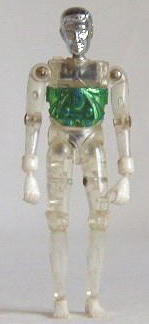
- Clear Microman
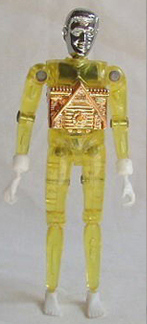
- Yellow Microman
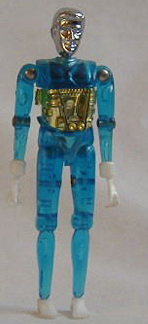
- Blue Microman
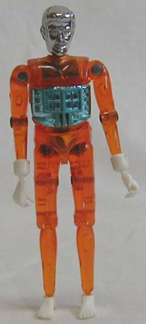
- Orange Microman
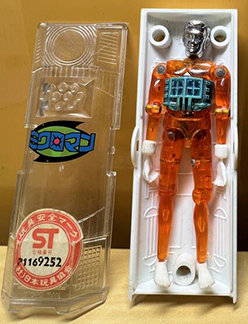
In additon to being released with their Micro-Kit, the barefoot figures also came as a capsule release, with the early large size ST sticker, and capsule cover variation featuring the circular etch pattern. Takara produced several varieties of the barefoot figures themselves, with early models using internal fastener types, before settling on the more common o-ring configurtion.
VEHICLES & PLAYSET
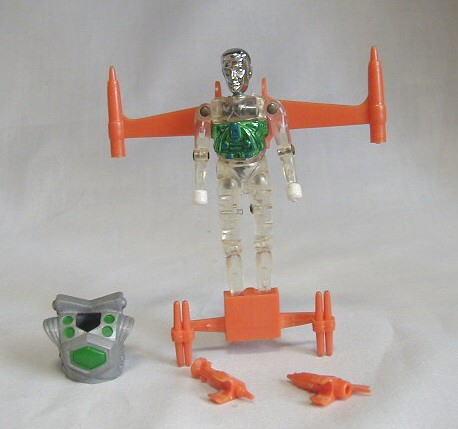
Micro-Kit Machine #1 Sky Rambler
- • It can operate underwater, on land and in the air, and is useful for rescue, reconnaissance and observation.
- • The light collecting device inside the breast converts light up to 1/1000 lux into energy.
- • When equipped with the Cosmo Wing, it can soar up to 1000m into the sky.
- • When equipped with the Jet Boots and Mach Ring, it can glide on land at 1000km/h.
- • The Green Breast can withstand the pressure of a depth of 1000m.
- • When equipped with a Power Ring on the arm, it can break through a 1m thick concrete wall.
- • The Super Gravity Protector can move freely, standing still or rotating in the air.
VEHICLES & PLAYSET
Micro-Kit Machine #2 Gyrotto
Micro-Kit Machine Gyrotto was one of the first four original Microman toys released by Takara in early 1974. The Gyrotto along with Hot Roader, Sky Rambler, and Beam Tripler were the very first series of Microman toys. They are one of the rarest and most sought after Microman toys. Gyrotto and the rest of Micro-Kit Machine are like their name sake a simple vehicle kit that must be put together. Each Micro-Kit Machine come with the original four "Founder" Microman - the M10X barefoot type. The toy is very simple but yet very elegant in design. Takara has already officially announced reproduction plan for Sky Rambler one can only hope they will follow through and reissue all the Kit-Machines.
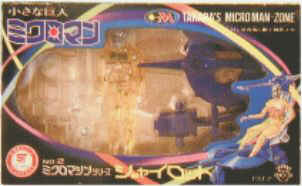
I never thought I would actually own an original toy from 1974 Microman-Zone. This particular Gyrotto is in mint condition (just a little dusty when I got it) and the Microman figure, to my surprise, is almost brand new looking, the joints are tight (even more so than the reissue one) and the rubber and plastic suffer no sign of deterioration. The seller inform me that this toy came from his childhood and it's the only one he ever own. He has no idea what it is and it has been in his attics for years.
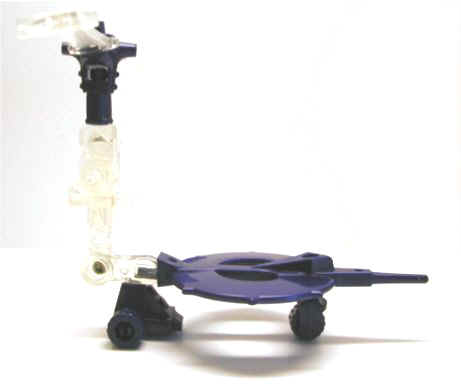
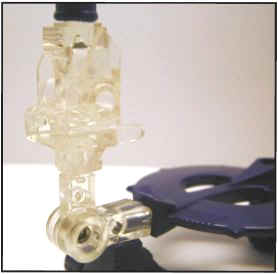
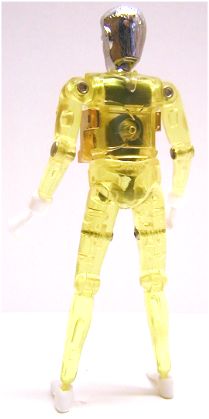
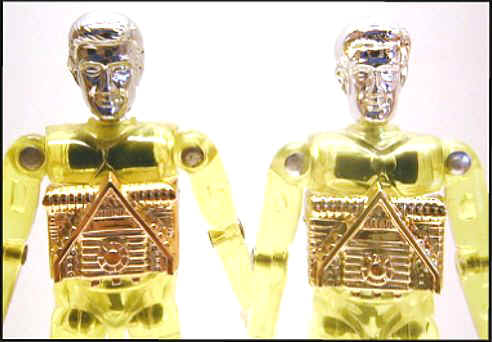
This is the first time I have a chance to compare the original vintage barefoot Microman to the one Takara reissue in 1998. The reissue is actually very good replica of the original. The reissue is slightly smaller than the vintage and the head is smaller and not quite as round in shape. The chest plate on M102 reissue also more gold-tone color than the copper-tone of the original version. To the right is comparison between the vintage M102 barefoot and the reissue M102. The original version actually held together pretty well, the hands, feet and chest plate don't fall apart like the reissue so the problem is not in the design but rather the defect in the replica versions.
VEHICLES & PLAYSET
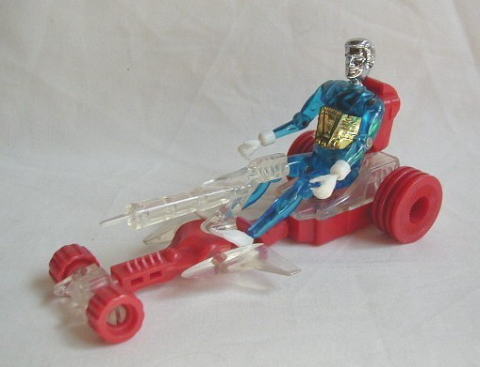
Micro-Kit Machine #3 Hot Roader
- • It is an attack combat vehicle that is mainly used on land.
- • The energy is converted into energy by a light collecting device inside the breast, which converts light up to 1/1000 lux.
- • The Yellow Breast can operate the Hot Loader at a speed of 1000 km/h.
- • The sound missile equipped on the tip is equipped with a sonic tracking device with a 100% hit rate.
- • The rotating cutting shovels on both sides are high-performance weapons that can even cut through steel.
- • The cycle barrier device uses energy from the photon engine to create an electromagnetic barrier around it to prevent enemy attacks.
- • The front beamer is a device that automatically avoids obstacles using sound waves.
VEHICLES & PLAYSET
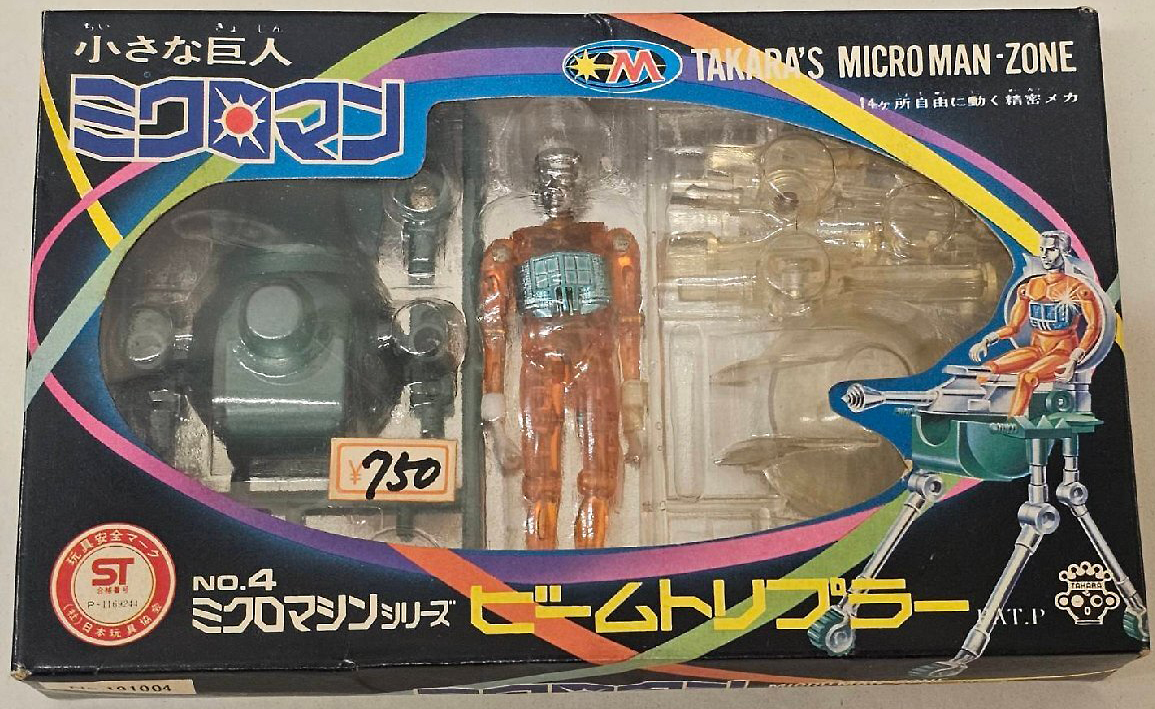
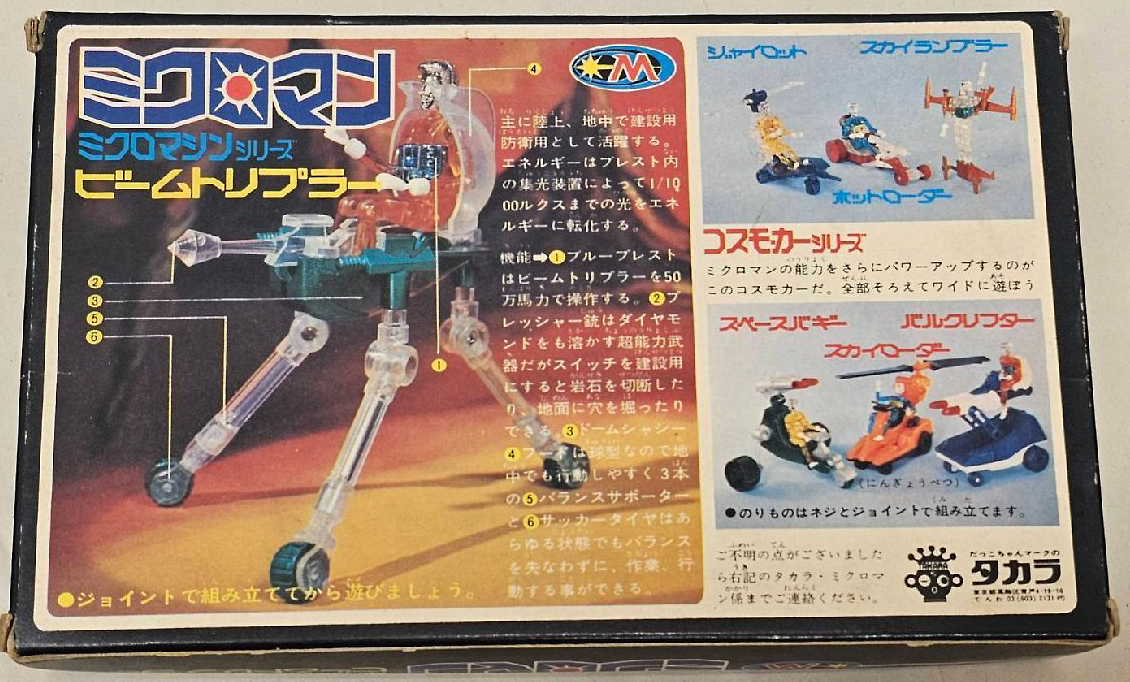
Micro-Kit Machine #4 Beam Tripler
- • It is an attack combat vehicle that is mainly used on land.
- • The energy is converted into energy by a light collecting device inside the breast, which converts light up to 1/1000 lux.
- • The Yellow Breast can operate the Hot Loader at a speed of 1000 km/h.
- • The sound missile equipped on the tip is equipped with a sonic tracking device with a 100% hit rate.
- • The rotating cutting shovels on both sides are high-performance weapons that can even cut through steel.
- • The cycle barrier device uses energy from the photon engine to create an electromagnetic barrier around it to prevent enemy attacks.
- • The front beamer is a device that automatically avoids obstacles using sound waves.
- • Mainly used for construction and defense.
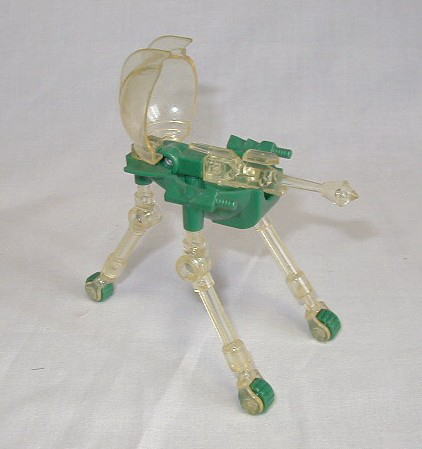
- • Energy is converted into energy by a light collecting device inside the breast, which converts light up to 1/1000 lux.
- • Blue breast operates a beam tripler with 500,000 horsepower.
- • The pusher gun (death ray gun) has a powerful destructive ability that can even melt diamonds.
- • Moreover, when the computer switch installed in the driver's seat is set to construction mode, it becomes a beam gun. A beam bar (light rod) is fired from the beam gun.
- • This beam bar is 1000 times stronger than steel and can cut through reinforced concrete and rocks, making it an absolute necessity for base construction. Also, when the beam bar is fired into the ground, it becomes a boring and can dig a vertical hole with a radius of 20m.
- • Moreover, when the beam gun is fired into the air by command of the Microman Tower, it creates a safety zone to protect children.
VEHICLES & PLAYSET
Cosmo Car Series MIC-1 Space Buggy
- Takara released second series of Microman Zone toys in August of 1974 following the release of the debut series Micro-(Kit) Machine. The second series was called Cosmo Car and consisted of three small un-powered vehicles MIC-01 Space Buggy, MIC-02 Bulk Lifter and MIC-03 Sky Roader. Unlike the first series Micro-Machine, these toys did not come with Microman figure and was sold in small box. Cosmo Car toys were originally retailed for about 700 Yen back in 1974. (In comparison, Micro Machine toys were sold for 750 Yen and Micro Base M115 Conning Tower was sold for 2500 Yen).
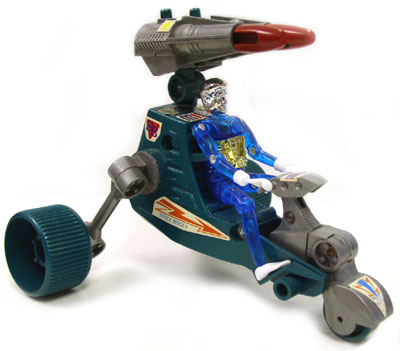
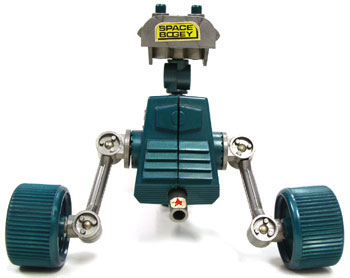
- Takara original marketing idea for Microman Zone was build around small size cyborgs with underlying theme of scientific exploration and construction. Following this theme, Cosmo Car toys were sold also as "construction" toys and required some minor assembly. Cosmo Car MIC-01 Space Buggy was the first vehicle in the series. Space Buggy (The sticker on the toy, however, had the the toy name as "Space Bogey"). Space Buggy was futuristic trike with missile launcher on top. Space Buggy (or Bogey, if you prefer) came with two missiles (with the nosecone painted red, a commonality for missile rocket back in 1960's and early 1970's). The missiles were spring loaded design and this was one of the gimmicks of the Cosmo Car series (Air Roader had spinning propeller gimmick). The second selling gimmick was the interchangeability of these Cosmo Car toys. This feature would later became one of the main selling point for later Microman line. Space Buggy featured standardized 5mm port and peg and the toy can be reconfigure in various ways or even combine with other two Cosmo Car toys for even more playability.
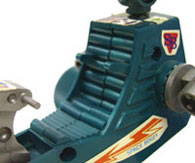
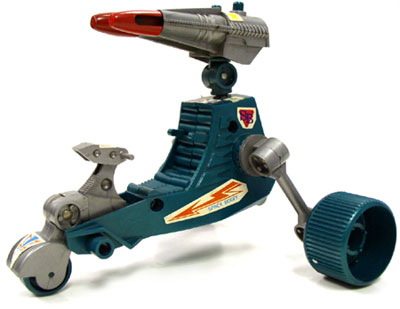
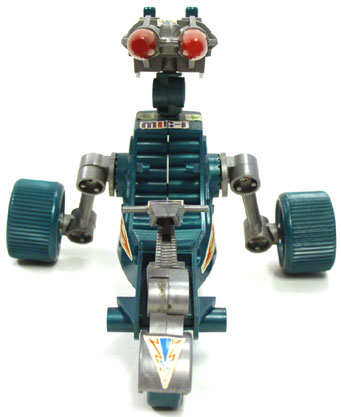
- Cosmo Car toys were designed exclusively for the early Microman Zone figure. At this early point, Microman were mainly sold as miniature or "micro" version of their Henshin Cyborg line. These Microman figures did not yet incorporate the 5mm standardized port. The seat for Cosmo Car toys, like that of the Micro Kit-Machine toys were fitted with small clip to hold the figure in placed. When Mego licensed Microman toys from Takara, Space Buggy along with Bulk Lifter, were sold as part of the early Micronauts line up. Bulk Lifter became Micronauts Hydra and Space Bogey became Galactic Cruiser. The third vehicle Sky Roader was never released as part of the Micronauts toys. Microman Space Buggy toy was slightly retooled for the Micronauts line (which debuted in 1976). The Micronauts version replaced the missiles with safety style "rubber tip" design that would became common with all the Micronauts toys that featured missile firing gimmick.
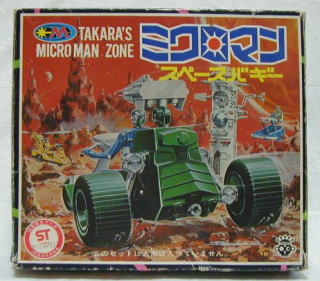
Packaging
Microman Zone toys came packaged in black color box with the "rainbow atomic ring" design. During the first year, the boxes had beautiful painting of the toys as box arts (common practice for toys from late 1960's and early 1970's). The painting box arts were later abandoned in favor of the photograph of kids playing with Microman toys.
The back of the box depicted the toy in various configuration (one of the selling point for the original Microman line). The back also show other toys in the series including two other Cosmo Car toys and the Kit-Machine series.
Inserts & Instructions
Cosmo Car toys came with B&W instruction sheet with details drawing of how to assemble the toy. This particular Space Buggy was a loose sample and did not come with box or instruction. The sticker was already applied by previous owner of this toy.
Microman Driver Not Included
While the Cosmo Car toys did not come packaged with Microman figures, the toys were design especially for these early Microman Zone Microman. The figures were sold with Microman Kit-Machine toys and later as individual figure inside white capsule case.
Screw Driver Included
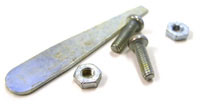
One of the selling point for Microman Zone toys was the emphasis on "construction" skill so many of the early toys came totally unassembled and must be bolted together by the included nuts & bolts and mini-screwdriver.
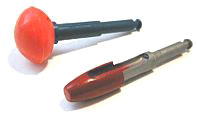
No safefy rubber for Microman. (Above is a comparison between Micronauts rubber tip missile and all plastic Microman version)
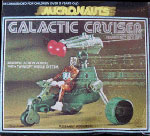
Mego Micronauts Version
Space Buggy was one of the many Microman toys that were licensed by Mego and sold as part of the Micronauts line in the US. Mego changed the name to "Galactic Cruiser" and the toy was slightly retooled with new safety tip missiles. (Above picture courtesy of Dave W. of Innerspace Online) For more information about Mego Micronauts version of Bulk Lifter please check out Dave Waugh excellent Micronauts website - Innerspace Online - Galactic Cruiser


VEHICLES & PLAYSET
Cosmo Car Series MIC-2 Bulk Lifter
- Takara released second series of Microman Zone toys in August of 1974 following the release of the debut series Micro-(kit) Machine. The second series was called Cosmo Car and consisted of three small un-powered vehicles MIC-01 Space Buggy, MIC-02 Bulk Lifter and MIC-03 Sky Roader. Unlike the first series Micro-Machine, these toys did not come with Microman figure and was sold in small box. Cosmo Car toys were originally retailed for about 700 Yen back in 1974. (In comparison, Micro Machine toys were sold for 750 Yen and Micro Base M115 Conning Tower was sold for 2500 Yen).
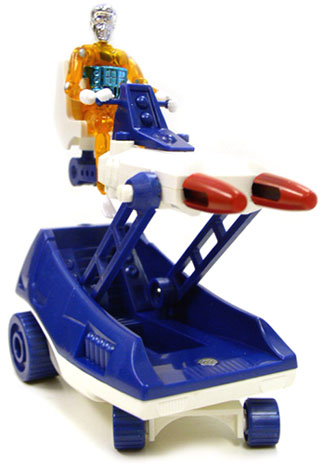
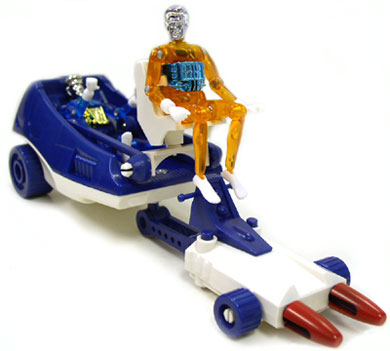
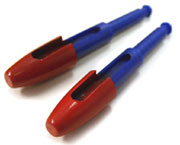
- Takara original marketing idea for Microman Zone was build around small size cyborg with the theme of scientific exploration and construction. Following this theme, Cosmo Car toys were sold also as "construction" toys and required some minor assembly. Cosmo Car MIC-02 Bulk Lifter was the second vehicle in the series. The design of Bulk Lifter was quite unusual with Microman seated on an elevated seat. Bulk Lifter had missile launcher and came with two missiles (with the nosecone painted red, a commonality for missile rocket back in 1960's and early 1970's). The missiles were spring loaded design and this was one of the gimmicks of the Cosmo Car series. The second selling gimmick was the interchangeability of these Cosmo Car toys. This feature would later became one of the main selling point for later Microman line. Bulk Lifter featured standardized 5mm port and peg and the toy can be reconfigure in various ways or even combine with other two Cosmo Car toys for even more playability.
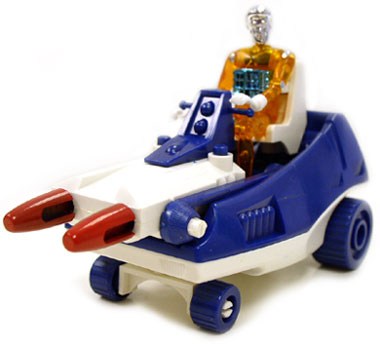
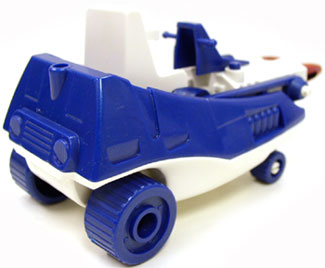
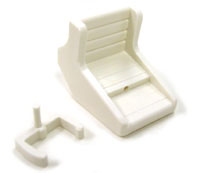
- Cosmo Car toys were designed exclusively for the early Microman Zone figure. At this early point, Microman were mainly sold as miniature "micro" version of the Henshin Cyborg line. The figures did not yet incorporate the 5mm standardized port. The seat for Cosmo Car toys, like that of the Micro-Machine were fitted with small clip to hold the figure in placed. When Mego licensed Microman, Bulk Lifter (along with Space Buggy) was sold as parts of the early Micronauts line up. Bulk Lifter became Micronauts Hydra and Space Buggy became Galactic Cruiser. The third vehicle Sky Roader was never released as part of the Micronauts toys. Microman Bulk Lifter toy was retooled for the Micronauts line (which debuted in 1976) and the clip style seat was changed (though the picture still appeared in the instruction sheet) and replaced with 5mm port style seat that utilized the "L" connector piece. Micronauts version also replaced the missiles with safety style "rubber tip" design that would became common with Micronauts toys that featured missile firing gimmick.
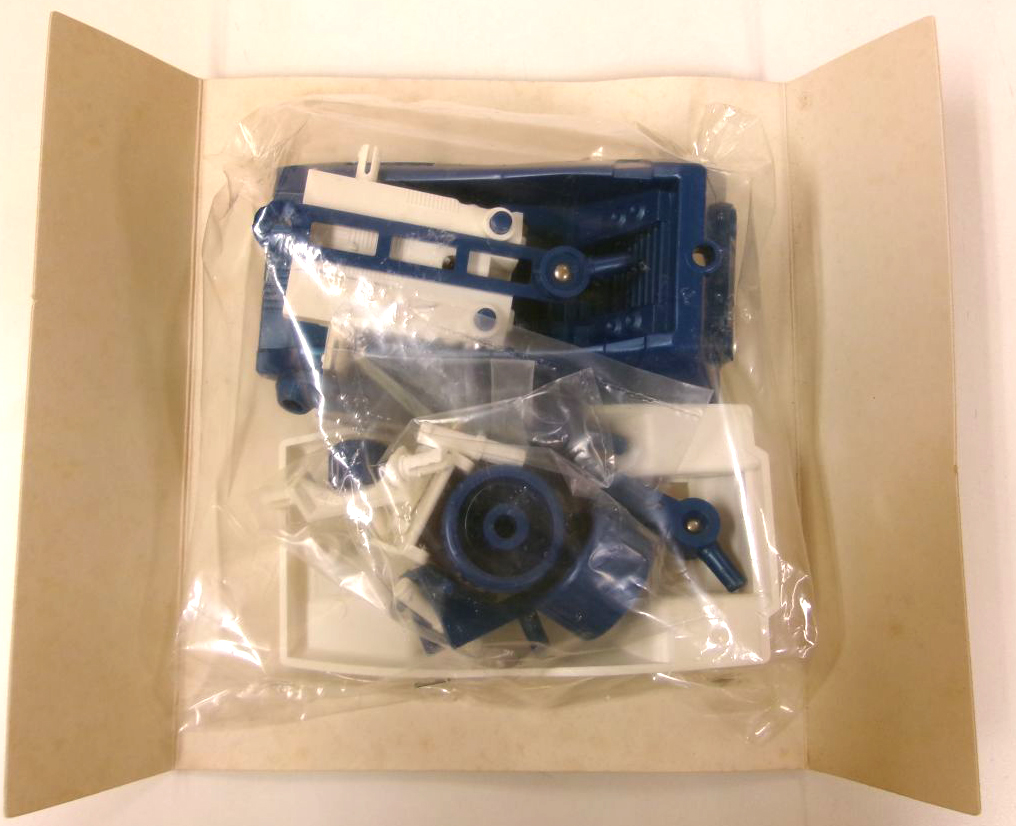
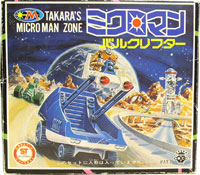
Packaging
Microman Zone toys came packaged in black color box with the "rainbow atomic ring" design. During the first year, the boxes had beautiful painting of the toys as box arts (this was a common practice for toys from late 1960's and early 1970's). The painting box arts were later abandoned in favor of the photographs of kids playing with toys.
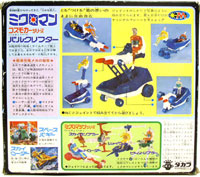
The back of the box depicted the toy in various configuration (one of the selling point for the original Microman line). The back also show other toys in the series including two other Cosmo Car toys and the Kit-Machine series.
Inserts & Instructions
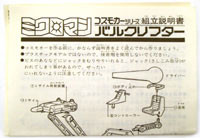
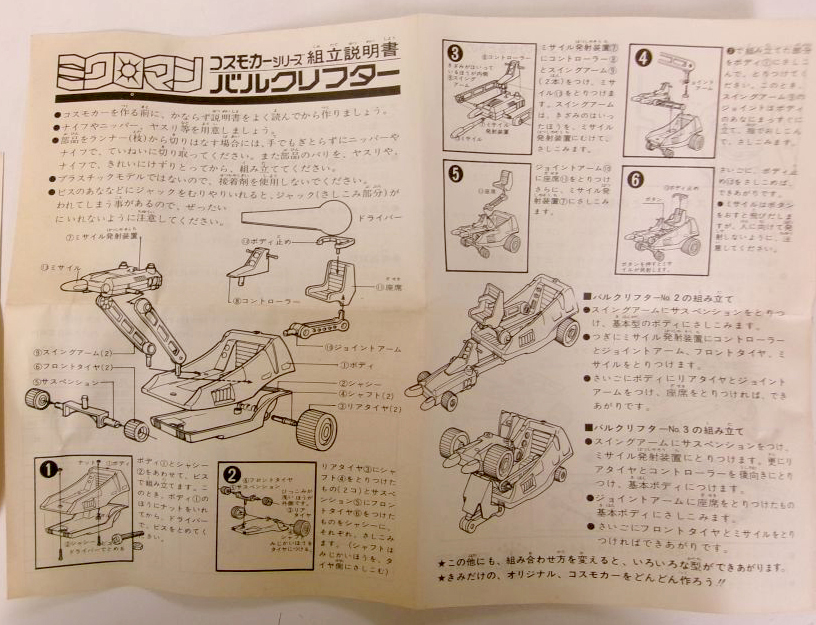
Bulk Lifter came with B&W instruction sheet with details drawing of how to assemble the toy.
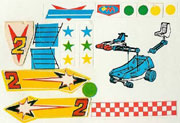
1974 version of Bulk Lifter did not come with the sticker sheet. It was not until 1975 that Takara began to include sticker sheet with Microman toys. (Below is a sample of sticker sheet from Micronauts version - Hydra)
Microman Driver Not Included
While the Cosmo Car toys did not come packaged with Microman figures, the toys were design especially for these early Microman Zone Microman. The figures were sold with Microman Kit-Machine toys and later as individual figure inside white capsule case.
Screw Driver Included
One of the selling point for Microman Zone toys was the emphasis on "construction" skill so many of the early toys came totally unassembled and must be bolted together by the included nuts & bolts and mini-screwdriver.
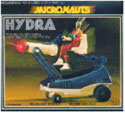
Mego Micronauts Version
Bulk Lifter was one of many Microman toys that were licensed by Mego and sold as part of the Micronauts line in the US. Mego changed the name to "Hydra" and the toy was slightly retooled with new seat and new safety tip missiles. For more information about Mego Micronauts version of Bulk Lifter please check out Dave Waugh's excellent Micronauts website - Innerspace Online - Hydra
VEHICLES & PLAYSET
Cosmo Car Series MIC-3 Sky Roader
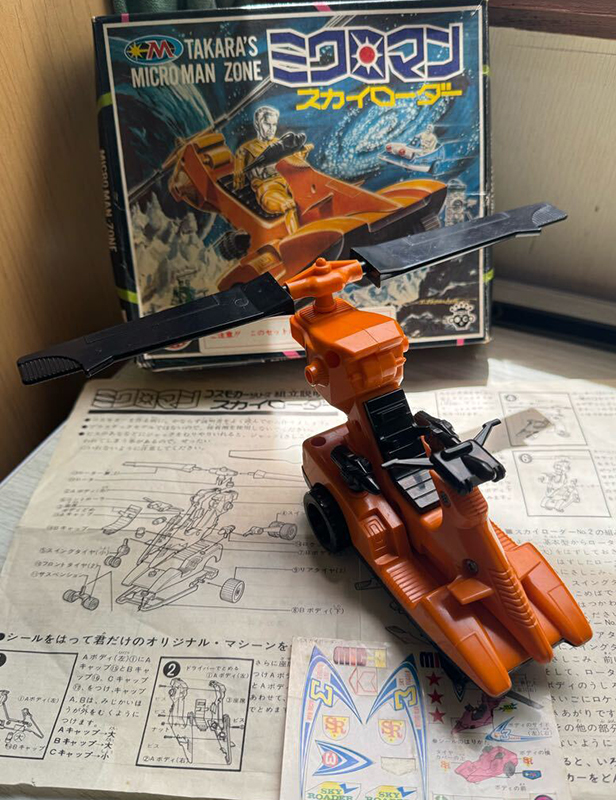
- It is an all-weather, all-purpose vehicle equipped with a super high performance computer that uses sunlight as energy to carry out reconnaissance activities on land, sea and air. It can travel freely across land, sea and air at a top speed of 2000kph.
- Equipped with a super high performance computer, it can store and reproduce 1000 times the amount of information in sound and video that a human could memorize in a lifetime.
The upper and lower parts of the body can be separated and can act separately using a remote control.
Packaging
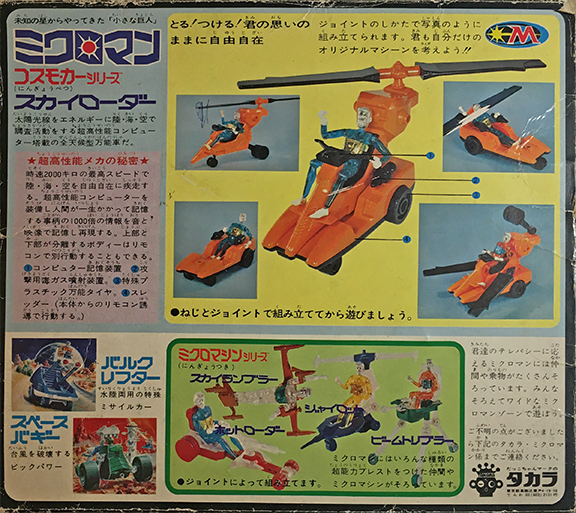
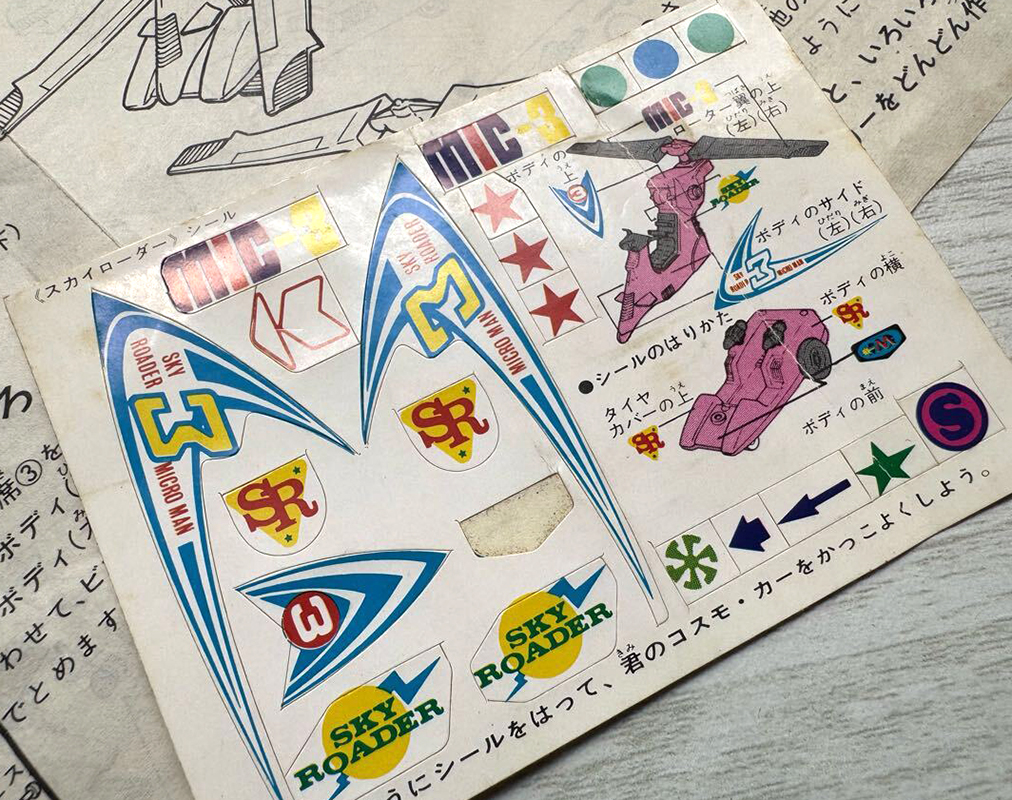
No Mego Micronauts Version!?!

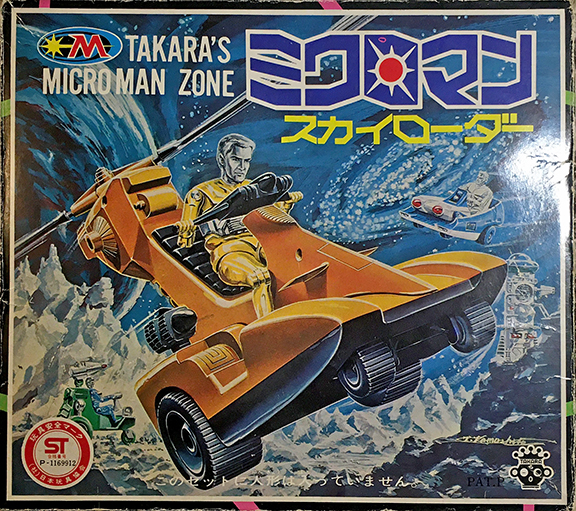
I don't currently know why this vehicle was not made into a Micronauts version. Frankly it's the sharpest of the three MIC vehicles and would have been pretty well appreciated by the overseas audience. I will supply more information as it comes in.
PLAYSET
Conning Tower Base M-115
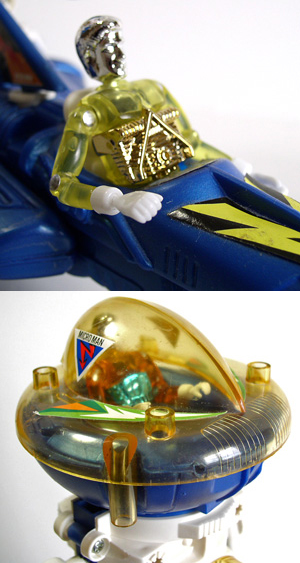
- Takara released Microman Conning Tower Base as part of the first year Microman line up. The base was the largest piece in 1974 Microman Zone line up and the centerpiece of the series. The original concept of Microman Zone was that they were smaller version of Takara Henshin Cyborg series and the reason for this was toy such as the Conning Tower would be prohibitive if not impossible to be release for the large 12" format line. The Conning Tower was sold for 2500 Yen back in 1974. In 1975, Takara reset Microman line and reintroduced the series as its own separate toy line from the Henshin Cyborg, the Conning Tower was reissued as part of the 1975 line-up with new box art and stickers for decoration but the toy itself remain unchanged.
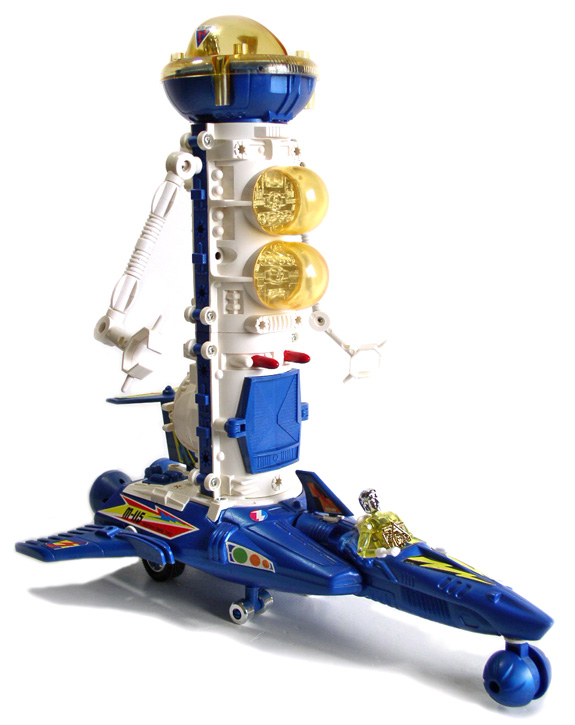
- The Conning Tower, like the rest of the toys during the first year of Microman was sold on the concept of "construction set" toy. The base comes in pieces and have to be put together using nuts and bolts (included). The toy also come with several extra pieces so the toy could be convert into different vehicles. The toy stand almost 14" tall and one of the most iconic piece in all of Microman line up. The Conning Tower would later be repackaged by Mego and sold as part of Micronauts series in the US and also to the rest of the world (outside of Japan) under the name M.E.L. (Mobile Exploration Lab).
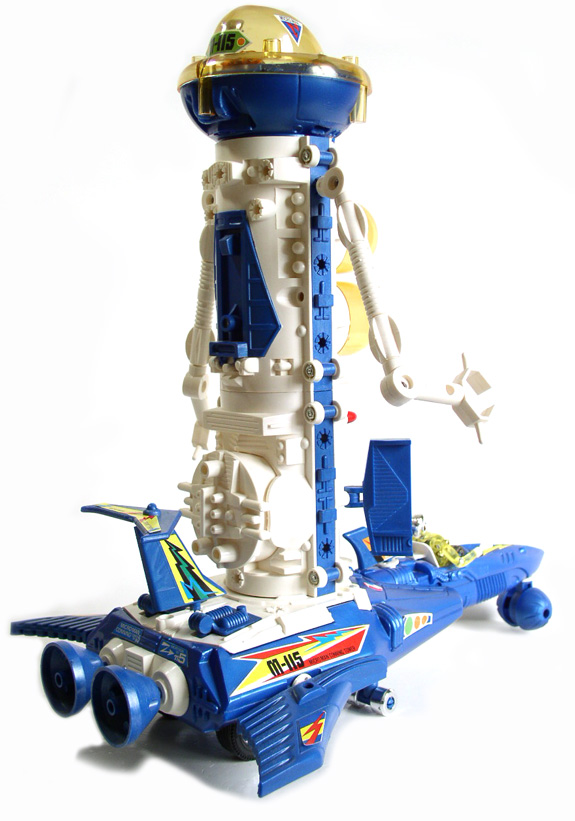
- Being part of the original first year Microman line, the Conning Tower was actually engineer for the first (the founder series) Microman figures which have the barefoot design and lack the 5mm port on their backs. While Takara did rework most of the vehicles from 1974 Microman Zone to better fit the 1975 and later Microman figures, the Conning Tower never got such retooling and the toy was simply repackaged and sold in the new line. This lead to the problem of very tight if not at all fitting of the figures into the vehicle seats. Some of the figures would only fit when the feet sections are removed such as the observation seat on top of the conning section. These seats would prove to be especially troublesome for the later bulkier Microman figures. It was not until 1979 that Takara finally re-engineered the Conning Tower.
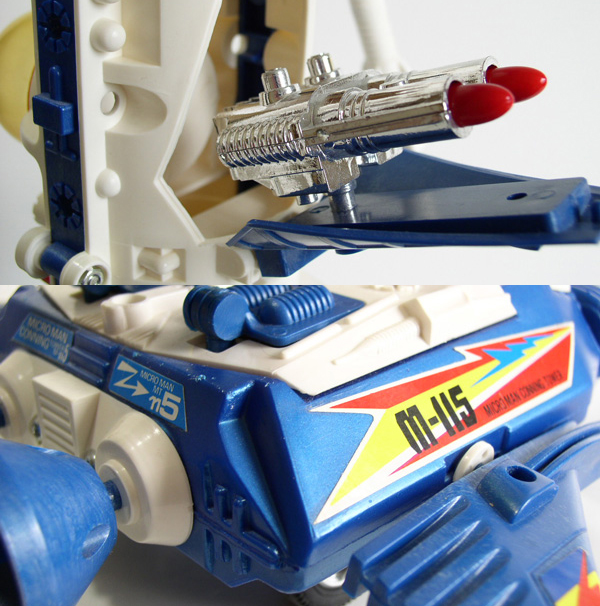
- The new version was sold as part of the Rescue Team Microman series and known simply as The New Conning Tower. Also being the first year toy, Coning Tower was the only original Microman vehicle to have a designation number (M-115) which Takara would later change and use numerical designation exclusively just for the action-figures. Interestingly, the newly design Conning Tower was destroyed in the subsequence year (in the catalog story) by super death ray blast from Death King.
Packaging
- Microman Base Series
- Conning Tower Base (early ver.)
- Released : 12/1974
- Retail Price : 2600 Yen
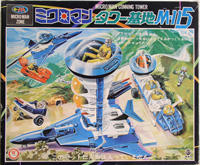
1974 version has painted box art typical of all the first year Microman Zone toys. This was a common practice for toys in the 60's and early 70's to use a beautiful commissioned artworks.
Packaging
- Microman Base Series
- Conning Tower Base (later ver.)
- Released : 11/1975
- Retail Price : 2600 Yen
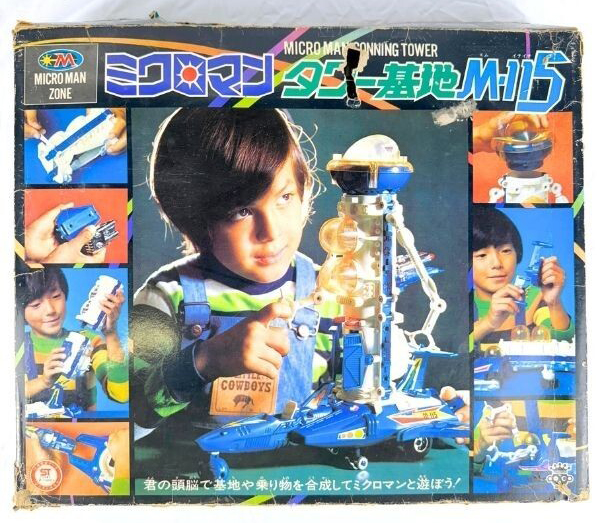
In 1975, Takara switched to using photograph of kids playing with the actual toys as box art for the Conning Tower. This change was done for all of Microman toys from 1975 on up until 1980 when painted box art would become fashionable again.
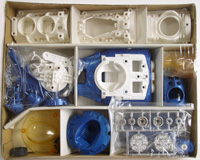
Packaging
Conning Tower comes in separated pieces and have to be put together.
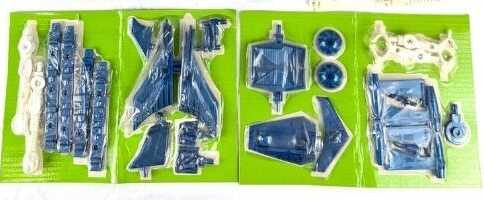
Interestingly, some of the second version parts came sealed on a bright green cardboard piece.
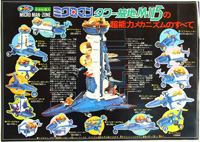
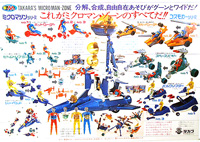
Inserts & Instructions
- Microman Base Series
- Conning Tower Base (later ver.)
- Released : 11/1975
- Retail Price : 2600 Yen
The toy comes with poster with information about the toy that also double as catalog on the reverse side. The instruction is printed on the box lid.
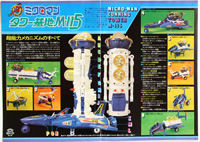
Inserts & Instructions
When the toy was re-released in 1975, Takara redesign the catalog and the poster info sheet to go with the newer Microman figures. Takara also included separate instruction sheet along with stickers for kid to decorate the Tower Base.
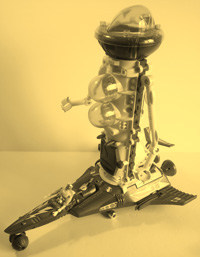
The Conning Tower Story
Microman constructed the Conning Tower base so they could broadcast the Spectrum MX Ray and revive other Microman from hibernations.

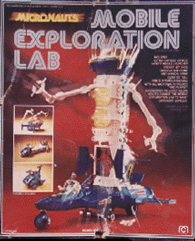
Mego Micronauts Version
Mego licensed Microman toy series from Takara in 1976 and released the Conning Tower as M.E.L. or Mobile Exploration Lab for the Micronauts series. M.E.L. version is mostly identical to Microman version with the exception of the missile launcher, the safety rubber tip missiles along with slightly alter sticker sheet (to remove Microman references).
(See Mego version of the Conning Tower - Micronauts MEL at Dave Waugh's Innerspace On-line)